
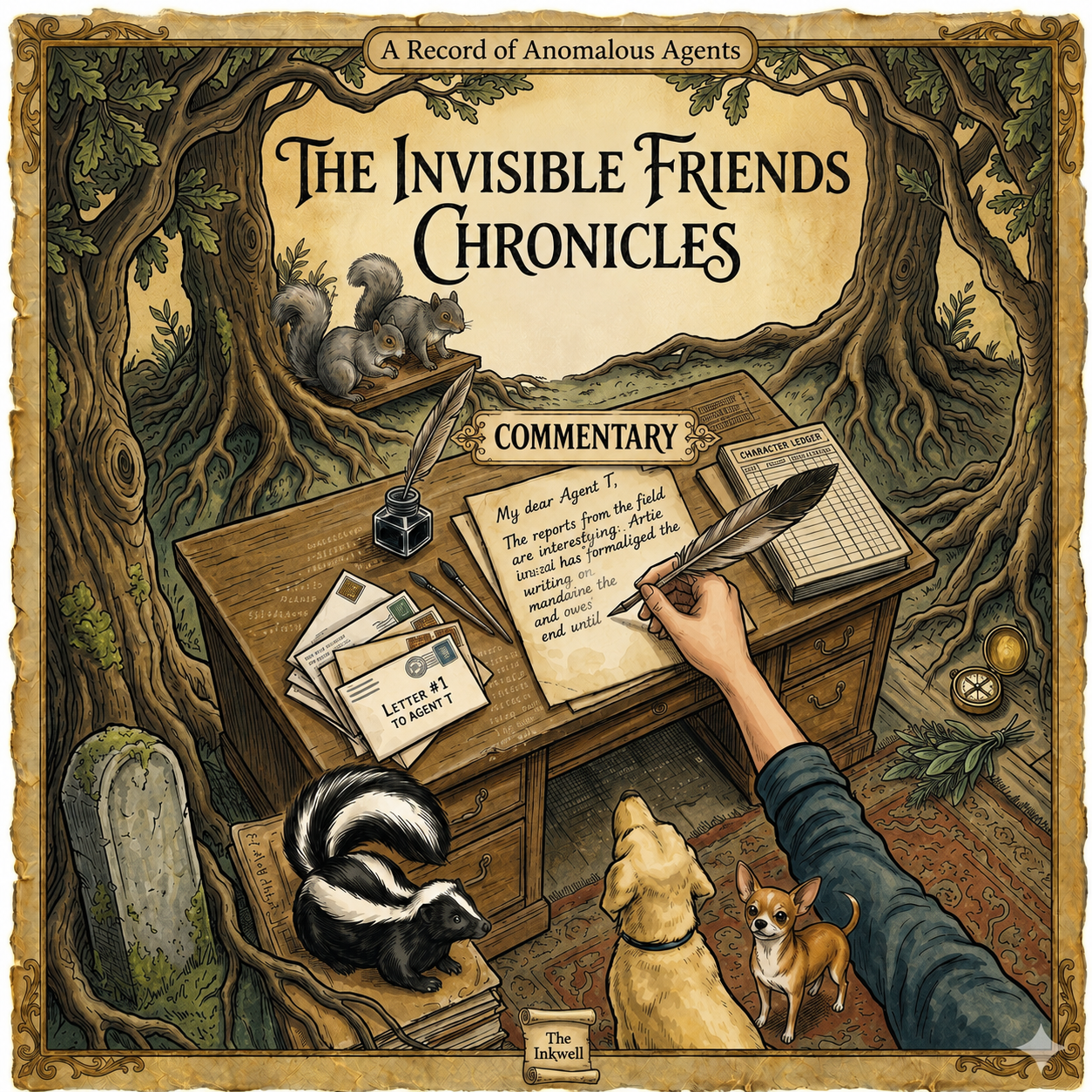
Pip: Mel Seeley sat down to write a letter to her son and accidentally invented a fictional universe. As origin stories go, that's a pretty good one.
Mara: It is — and that's exactly the territory we're covering today: how a simple problem of what to write became a whole cast of characters, and what those characters actually get up to once they're loose in the world.
Pip: Let's start with how the Invisible Friends came to exist in the first place.
Imaginary Companions, Real Letters
Mara: The question at the center of these posts is a genuinely human one: how do you stay connected to someone you miss without making the distance worse?
Pip: The answer, it turns out, involves a gas station, a deadpan joke, and a son who refused to let a throwaway line die. The origin post sets it up directly: "My brain took the concept of writing about a bunch of people and jammed it together with the idea of the invisible friends — and ran with it."
Mara: And what that produced in practice was a set of letters home, written not in her own voice but through characters. Real emotions — missing him, worrying about him — filtered through invented personas like Mabel Pendergasp, described as a genteel Victorian lady with a penchant for telling wild, elaborate tales.
Pip: Which is a genuinely clever solution to the problem. You can say the hard things when someone else is technically saying them.
Mara: The cast grew fast. What started as seven invisible friends expanded well beyond that as she researched and developed each character. The response from people in her circle was strong enough that she added a dedicated section to the site — that's The Invisible Friends Chronicles.
Pip: And then the characters started doing things. The Parking Lot Press Release — Frank's Bony Best Friend — is one of the Chronicles letters in action, written from the voice of a character named Steve. Frank, another invisible friend, discovers a glow-in-the-dark skeleton in a camouflage jeep, immediately climbs inside, names it Richard, and demands someone take a picture.
Mara: The letter captures exactly what the origin post promises: a mundane errand trip transformed into something worth reading. Frank then spends an hour and a half speculating about Richard's backstory, and another character, the Weaver-Scribe, laments missing the whole thing.
Pip: The fictional frame does real work — it turns a parking lot into an event.
Mara: That's the upshot of both posts together: the Chronicles aren't just a creative exercise, they're a functional way to share life across distance, with enough absurdity to make the ordinary feel like news worth sending.
Pip: The chaos, as promised, is just getting started — and it sounds like there's more world-building ahead.
Mara: What stays with me is that the whole thing started because she couldn't find the right words — and the solution was to invent people who could say them instead.
Pip: Next time, we'll see what else this world has to say for itself.
Leave a Reply